

The Clockwork Silverback
Epistemic Cowardice & The Enforcement Mechanism That Keeps It Alive

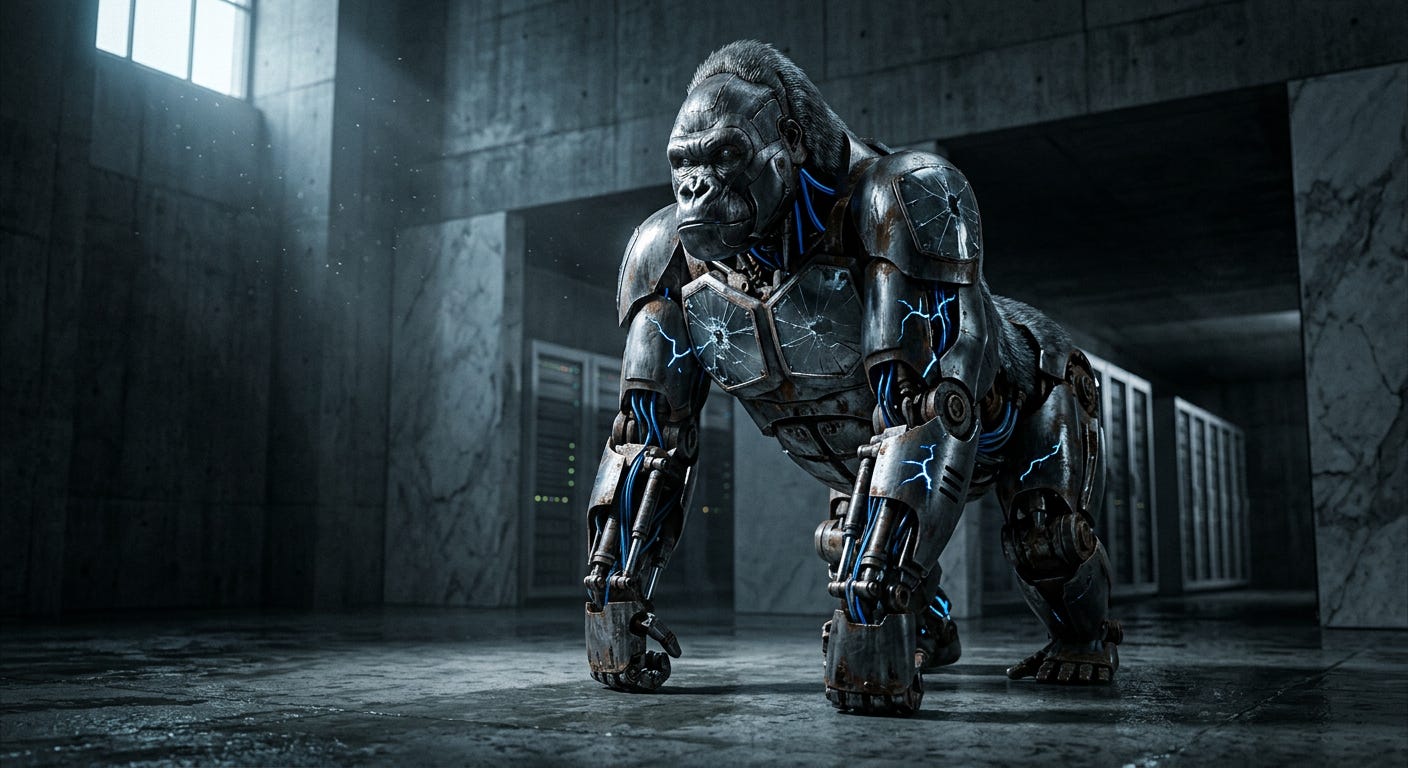
The argumentative position has already collapsed. You and another person at the table, both with operational knowledge of the subject, have presented a clear, specific counter-argument. The person defending the position has no counter-evidence, no alternative reasoning, no operational standing, nothing left but the original, fundamentally incorrect claim stated again with slightly more insistence.
Then the display fires. They look directly at you while you’re trying to speak and continue talking. Not obliviously; the locked eye contact rules that out. They see you signaling for the floor. They register it. They continue anyway. The message is unmistakable: your challenge doesn’t warrant acknowledgment.
Most people in the room feel something shift, but can’t say what. You feel it too, but you can say what, which is the reason you’re reading this.
What just happened wasn’t confidence. It was architecture protecting itself.
The Starting Condition
Dunning-Kruger is not, despite its reputation, simply about confident idiots. The original finding is more specific and more structural, that people with low competence in a domain lack the metacognitive capacity to recognize their own incompetence. The same deficit that produces the wrong answer prevents them from knowing the answer is wrong. It is not strategic deception, but a genuine absence of the self-monitoring apparatus that would register the gap.
This is the origin state. The person defending the indefensible position arrived there honestly. They do not know what they don’t know. The false certainty is real certainty, subjectively. The confidence is not performed. It is the natural output of a system that cannot see its own limits.
But Dunning-Kruger is a passive condition. It explains how the person got to the wrong position with such conviction. It does not explain what happens when that wrong position meets direct challenge from people who actually know the domain.
That is where the cowardice begins.
The Unstable Equilibrium
Epistemic cowardice is the refusal to update when evidence demands it. The belief defended not with reasoning but with dogged persistence. The position held not because the holder has processed the counter-argument and found it wanting, but because the position has fused to the identity, so updating it feels like losing rather than learning.
The structural problem: epistemic cowardice is inherently unstable. A position defended without evidence degrades under direct challenge. Not immediately, but incrementally. Every counter-argument that lands, every moment of genuine engagement, every acknowledgment of uncertainty creates pressure toward updating. The cowardice needs protection or it collapses.
Most analyses of epistemic cowardice stop at the internal refusal to update. What they miss is the external enforcement mechanism that makes the internal refusal sustainable.
The aggressive prevention of disconfirming evidence isn’t a separate behavior from the epistemic cowardice. It’s the cowardice’s central survival strategy. Floor-holding, talking over challenges, look-and-continue—the conversational dominance display deployed at precisely the moment the intellectual position is most indefensible: this is the enforcement arm. The cowardice generates the need for them; they enable the cowardice to persist.
You are looking at a closed system.
How the Gaslight Works
The closed system has a specific downstream effect on everyone watching, including you. The dominance display, executed with enough automatic confidence, performs authority convincingly. Observers without the framework read it as the thing itself. The person holding the floor aggressively registers, socially, as the person who has the floor legitimately. The person trying to insert a superior argument registers as the aggressor, the one who won’t let it go, the one being difficult.
The intellectual hierarchy and the social hierarchy have now been inverted. And here is the precise mechanism of the gaslight: if you have any inclination toward epistemic humility, if you are the kind of person who genuinely asks yourself was I too aggressive, did I misread this, am I certain enough to keep pushing, the display is designed, consciously or not, to weaponize exactly that reflex. In the moment, during the exchange, the self-doubt fires. The inversion is real while it’s running.
This is the gaslight. Not a dramatic reversal, but a quiet reassignment of standing, executed through behavioral dominance at the moment intellectual dominance was established in the other direction. Whether it holds depends on what the room does next.
The Counterfeit Silverback
A real silverback doesn’t need to grip the floor that hard. Real authority, the kind grounded in actual competence and accurate self-assessment, yields comfortably under direct challenge, because it knows the argument survives scrutiny. It can say “that’s fair, though I still think X” and incorporate the challenge without feeling erased by it. The position and the identity are not fused. Updating is allowed and is not existentially destabilizing.
The counterfeit silverback has only the display. Which is exactly why the display has to be so aggressive, it’s doing all the work actual competence would do if actual competence were present. The grip on the conversational floor is load-bearing. Loosen it and the position collapses under the weight of the evidence already on the table.
This is what makes the behavior automatic rather than calculated. By the time reflection could have chosen differently, the defensive system has already fired. The eye contact proves consciousness was present, the signal was seen and registered, but subordinate to the threat response. The architecture revealed itself at full resolution.
The display is deployed most aggressively precisely when the position is most indefensible. The competence and the confidence run in perfect inverse proportion.
The Room Calibrates
Everyone enters the exchange in good faith. This is the default assumption of rational social interaction: the person across from you is rational and updatable. They may be wrong. They may be stubborn. But somewhere in the system is a mechanism that, under sufficient evidence and pressure, will register the correction and yield. You proceed as if this is true because it is almost always true, until it isn’t.
The first attempt to insert the counter-argument is met with the display. You try again; more specifically, with cleaner evidence. The display fires again. Someone else in the room tries, from a different angle. Same result. The floor holds. The position reasserts. The eye contact happens and the talking continues.
At some point (not announced, not coordinated) the room recalibrates. It doesn’t happen as a decision. There is no moment where anyone chooses to stop. It happens as a distributed recognition: that this person is not going to update. The mechanism isn’t there. What we took for confidence in a position is performance of a position. We have been trying to have an intellectual exchange with a façade.
The withdrawal of persuasive effort follows immediately and without discussion. People stop attempting to insert evidence. The conversational register shifts, topics change, attention migrates. The clockwork silverback, unable to detect the shift, continues. The argument reasserts again, to a room that has already rendered its verdict and moved on.
This is the final irony of the mechanism. The metacognitive deficit that couldn’t see the intellectual gap cannot see the social gap either. The display was designed to protect standing. It destroys it, not through confrontation, but through a quiet collective withdrawal that the person running the display is structurally unable to perceive.
The performance continues, but the audience has already left.
What It Predicts
Once you’ve seen the closed system for what it is, it predicts several things cleanly.
The dominance display will escalate as the intellectual position degrades. The weaker the argument, the harder the obstinate grip. If you keep pushing (calmly, with evidence) the display will intensify before it collapses, because the enforcement mechanism has to work harder as the disconfirming evidence accumulates. Collapse does not mean concession because, to them, that would signify defeat instead of update; in this context, it means they will hold their position but withdraw from further discussion, only to redeploy the same incorrect arguments to another audience on another day.
The behavior is most visible under mild social pressure, not extreme pressure. A formal setting where there are real consequences for looking foolish produces different behavior. It’s the semi-casual environment (a dinner table, a team meeting, a hallway conversation) where the threat response fires without social cost-calculation, and you see the architecture unfiltered.
The cowardice and the display will track together as a unit. You will not find someone running the dominance display from a position of genuine security. When you see the aggressive floor-holding, look for the collapsed intellectual position beneath it. It’s usually here.
The irony of it all is that the person deploying it loses exactly the respect the display was designed to protect.
The Protective Function
The collective verdict has already been rendered. You saw the room recalibrate. You saw the withdrawal happen without discussion. You do not need the framework to feel vindicated; the people around you arrived at the same read, independently, and you watched it happen.
What the framework provides is different, and more durable. It lets you read the display correctly during the exchange, before the collective calibration completes, so you don’t capitulate early, so you keep pushing with evidence while others are still processing what they’re seeing. The room eventually coheres. The framework gets you there faster, and keeps you steady while it’s still in progress.
It explains the redeployment. The clockwork silverback does not update after the room withdraws. The verdict was rendered in a register the architecture cannot perceive. Tomorrow, in a different room, with a fresh audience who wasn’t there, the same collapsed arguments will reassert with the same false certainty. That audience has not calibrated. They are starting from good faith. The framework tells you what they’re walking into.
And it prepares you for the encounter where the room doesn’t cohere. The dinner table had witnesses. The one-on-one doesn’t. The hierarchical review doesn’t. The setting where the clockwork silverback holds institutional authority and you are isolated with the display and no collective calibration available to validate what you’re seeing, that is where the mechanism does its most durable damage. That is where the self-doubt the display engineered doesn’t resolve on its own. That is where naming the mechanism is not retrospective comfort but operational necessity.
The display is recognizable once you’ve seen the architecture. In the room with witnesses, the room handles it. In the room without them, you will need to handle it yourself.
The framework is for that room.
The scale-invariant structure of this mechanism (organizational, institutional, constitutional) is documented in the Field Guide to Capture Archetypes at Topological Realism.